Showing posts with label crime. Show all posts

Tuesday, March 10, 2015

What I've Been Reading: City Noir

Istanbul Noir edited by Mustafa Ziyalan and Amy Spangler

Ok, do you all know about Akashic Books City Noir series? So far there are sixty-nine titles (I think I counted that correctly)-- each is an anthology of noir short stories, taking place in a specific location, with the stories written by authors who are from there or live there, or write about the city a lot. Many of the volumes are international--if I counted correctly, 24 of the currently-out titles are international, with locations ranging from Paris to Manila, Kingston to St. Petersburg, Tehran to Copenhagen. (There are also 3 titles coming out this summer-- Providence, Beirut, and Marseille-- and another 21 that have been announced. Of the 24 that aren't out yet, 16 are international.)

I love this series so hard. It's the best of armchair travel, because you're going into neighborhoods and situations you don't usually get (because, well, noir). As the authors are mostly local, or write like a local, the city is the setting, and it's a character that links the stories, but there's no expositional tour guide voice that can run through books that take place in a location the readership might not know very well. There's just the city and culture in the background and part of the story, which in a way is more enlightening. Between all the stories, you usually get a wide range of neighborhoods, people, and economic status--and not a lot of the touristy stuff we usually see. While the concept itself is diverse, there's also tremendous diversity within each volume. Also, with the international ones, you get to read a lot of authors that haven't published in English before, or that you might not otherwise have come across.

So, as much as I read and love this series, I haven't reviewed it yet because, well, Istanbul Noir is the only one I've actually finished. Not because the others aren't good, but they're short stories! So I tend to dip in and out of the collections, and then they're due back at the library, and so I'll return it and pick up a new city. I've found short stories are the best bus reading, because that's usually how long I have. I haven't really gotten into short stories before, but I think my friend and co-worker Megan put a finger on it when she explained why she doesn't like them--they're too short for her to really connect to and like a character. That's the best part about noir--you're not really supposed to like most of these people.

So! If you're looking for some great short stories by authors you may not know, or want a new look at a city you love, or a very different introduction to one you've never been to, this series is for you.

Also, what cities do you wish they covered? Personally, I'm crossing my fingers for Shanghai, Tokyo, Hong Kong (and maybe a separate Kowloon volume, like they split up the boroughs of New York City?), Cape Town, Jakarta, Kuala Lumpur, and Karachi.


Book Provided by... my local library

Links to Amazon are an affiliate link. You can help support Biblio File by purchasing any item (not just the one linked to!) through these links. Read my full disclosure statement.

Monday, June 11, 2012

Midnight in Peking

Midnight in Peking: How the Murder of a Young Englishwoman Haunted the Last Days of Old China Paul French

It's taken me a few days for me to say anything about this book besides "I just... wow. I mean, it's just, Beijing and... wow. I mean... wow." And that goes for the rather explosive content and also the way French can spin out a story. (I mean, wow.)

In early January, 1937, the night of Russian Christmas, Pamela Werner was murdered. Horrifically. Her body was found the next morning outside the supposedly haunted Fox Tower in Beijing.* She lived with her father in the Tartar city, just outside the Foreign Legation, so the investigation is under the control of the Chinese police. But she's a British subject, the daughter of a former British Consul, and this isn't an average robbery gone wrong. To get around the British legation promoting an envoy to the case that they would control, the Chinese police appoint a detective from Tianjin, where Pamela went to boarding school. DCI Dennis was former Scotland Yard and wasn't under the legation's control. His hands were tied by the British as to what he could and couldn't do, but he wouldn't get in the way of the investigation.

But the British want to save face and hinder things at every turn. The Consul in Beijing has a personal dislike of Werner's father. National and personal politics play large. The White Russians who run the Badlands, the strip of seedy dive bars, opium dens, and brothels between the Legation Quarter and the Tartar city, aren't talking. In Tianjin, Pamela was a quiet school girl. In Beijing, she had several boyfriends and liked to party. Meanwhile, the Japanese are surrounding the city and getting ever closer. Everyone's fleeing-- either the investigation or the threat of war.

The murder remains unsolved, and the case technically open, but no one working on it. Pamela's father starts his own investigation and gathers his own evidence and reaches his own conclusions about who murdered his daughter. The Japanese get involved. Then they're not. Different personal and national politics at play, but they still have a major role in the investigation. Pamela's father has a compelling case to make against his main suspect (one that French agrees with) but the Consul and London are ignoring his pleas and evidence. Personal politics make it easy to write him off. The war makes it easy for his files and notes to get shoved in a drawer and lost (until French found them in an uncataloged file at The British National Archive in Kew.)

Was it the KMT? The Japanese? A jealous boyfriend? Was it a message to someone else? Or something far more sinister? (Answer: far far far more sinister.)

Secret nudist colonies, stateless prostitutes, political assassinations, and cocktail hours spent at smoky back tables gathering gossip, rumor, clues and evidence, Shura**... and a world on the brink of war. Basically, but John LeCarre and Eileen Chang in a blender and make the result a true story, and you get Midnight in Peking.

French has a gift for spinning out the suspense and tension. He deftly explains the back-history and the politics, making it understandable so the reader can get a sense of the all the factions at play, but without letting it get in the way of the story he's trying to tell. It's a powerful, gripping read.

I will warn you it's not for the faint of heart. Pamela's murder is truly horrific. Both the state of her body and the conclusions Werner reaches are beyond any Law & Order episode.

The end papers of a beautifully illustrated map of Old Peking, BUT they don't function as the most useful map. This book really needs a good map to help the reader get his or her head around the geography of everything.

It's a fascinating and distressing look at the last days of colonial Beijing. It's a page-turning murder mystery. And I mean... wow. Just... wow.


*Beijing = Peking. They are pronounced exactly the same. Throughout the book, French uses the old Wade-Giles system of Transliteration. Tianjin reverts back to Tientsin. I assume it's because it's more historically accurate. The Pinyin Romanization standard was invented by the communists over a decade after the events in this book. It also adds to that colonial old-world feel that pervades the drawing rooms and hotel bars where the action takes place. However, as someone whose mind works in Pinyin, this took a bit getting used to. Although, if you want to be super-technical about it, at the time this book takes place the city's name had been changed to Beiping/ Pei-p'ing because jing means capital and in 1928, Chaing Kai-Shek had moved the capital back in Nanjing (Nan means south, Bei means north) so Beijing was no longer the capital and so its name changed (back) to Beiping (ping means plain. The city had been named Beiping at the beginning of the Ming dynasty, when the Ming capital was at Nanjing. Before then, it had a few different names.) Until 1949 when Mao moved the capital back to Beijing and changed the name back. Interestingly, Nanjing never changes its name when it's not the capital. Thus endeth my supreme nerdiness.

**Shura was a half-Chinese, half-Russian of indeterminate sex who passed as man or woman, European or Chinese, depending on Shura's mood. Shura was a wine dealer, cabaret star, and a jewel thief. After the Bolsheviks murdered Shura's Tsarist official parents, Shura walked across Siberia and Mongolia to get to China. You know, AS YOU DO. Shura is a minor character, who greatly helps Werner's investigation, but I'm currently mildly obsessed.

Book Provided by... my local library

Links to Amazon are an affiliate link. You can help support Biblio File by purchasing any item (not just the one linked to!) through these links. Read my full disclosure statement.

Monday, October 11, 2010

Griff Carver, Hallway Patrol

Griff Carver, Hallway PatrolGriff Carver, Hallway Patrol Jim Krieg

Griff is transferring schools after an incident at his last one. He's been told not to do safety patrol again-- he takes it too seriously, but protecting the hallways is in his blood. What he finds is a shady student council election, a fake-hall pass ring, and a police chief on the take, and they're all related. Plus, the sassy girl reporter and the over-achieving sidekick.

It's all done in a very pulp crime noir dirty-backroom politics, but in junior high.

It's a straight-send up and done very, very, very well and I really liked it but... I'm not sure that kids will. They're not as familiar with hardboiled detective novels and movies like this is based on and... it's not an overtly funny story. It's not really supposed to be, but I'm not sure what's there for kids to like. And the junior high setting gets a little old for adults reading purely for their own entertainment.

So, I'm more than a little torn. Did I love the scene where Griff can't take it anymore and is drinking himself into a sugar coma instead of an alcoholic one? Yes. Was it funny... only because I know that instead of an arcade with soda, it should have been a smoky bar and shots of whiskey. The humor comes from the subversion of the setting, stock characters, and tropes. And it's a subtle thing that I'm not sure the target audience will get.

However, I hope I'm wrong.

Book Provided by... my local library

Links to Amazon are an affiliate link. You can help support Biblio File by purchasing any item (not just the one linked to!) through these links. Read my full disclosure statement.

Saturday, November 21, 2009

The Bunnies are a sign of EVIL


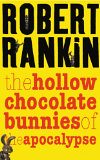
The Hollow Chocolate Bunnies of the Apocalypse Robert Rankin

Jack has come to the city to seek his fortune. Little does he know that the city is actually a Toy City, inhabited by hard-drinking teddy bears, promiscuous dollies, and tin toy bartenders. He soon teams up with Eddie, one of the hard-drinking teddies to solve a series of murder cases of the city's most prominent members--Nursery Rhyme characters. They're not toys. They're meat and they're being murdered in horrific ways. Jack and Eddie seek to find out in this noir crime fiction with a madcap and zany twist.

Obviously, this will draw comparisons to the work of Jasper Fforde (who is one of my favorite authors). Rankin is less zany and weird, and much darker, keeping more in line with the conventions of pulp crime fiction. However, if you have a dark demented sense of humor (like me) this is really funny and rather well done. I loved exploring the divide between toy and meat, and the politics of the different types of toys. I also loved the different toy religions and how they differed and how they came about. I'm looking out for other Rankin books now.

Book Provided by... a friend of mine who thought I'd like it. She was right!

Links to Amazon are an affiliate link. You can help support Biblio File by purchasing any item (not just the one linked to!) through these links. Read my full disclosure statement.

Monday, February 16, 2009

Cybils Winners!

Did y'all check out the Cybils winners that were announced this weekend?

I was on the MG/YA nonfiction panel, so I thought I'd discuss the winner for nonfiction Monday!


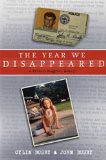
The Year We Disappeared: A Father-Daughter Memoir Cylin Busby and John Busby

John Busby was a police officer on Cape Cod who was about to testify against the brother of Raymond Meyer, a known arsonist and suspected murderer. On his way to work one night, he was shot in the face. If he survived, John knew that Meyer would come after his family next. He also knew that Meyer would only know where John was going to be if someone on the force had leaked that information.

Cylin was 9 when someone tried to kill her father. All of a sudden, there were policemen guarding her house, following her to school, standing outside her classroom door... she wasn't allowed to go over to anyone's house, no one was allowed to come over to hers.

John was frustrated and angry at the lack of progress being made in the investigation. He couldn't talk and had to take his meals through an injection in his stomach, and later through a tube.

Cylin knew she was supposed to pretend that everything was fine, and that life was going on as normal, but it wasn't.

The Busbys tell their story in alternating chapters, giving us both sides of their story--Cylin's chapters keep their child-eye's view, and John's give us the information on the investigation and his medical progress. The book is gripping and a page-turner, with something to appeal to everyone. Some readers will respond to Cylin's feelings of confusion and fear, some will appreciate the police procedural and medical information. Overall, a strong book and a strong winner.

One of my other favorites on the short list was...

Body Drama: Real Girls, Real Bodies, Real Issues, Real Answers Nancy Redd

Usually, when it comes to body stuff for girls, books fall into 2 categories--books about puberty and books about sex. Redd's doesn't--this is a book that is about your body and not sex, but it's for the post-pubescent woman. It covers a range of topics--everything from corns and warts to facials, body piercings and zits, lice and facials, stretch marks and skid marks. The overall image is that yes, I know you feel like a freak because your body does this, but guess what! most bodies do and everyone's feeling like theirs is the only one!

Best of are Redd's confessions throughout the book--about all the embarrassing things she's talking about and how yes, they have happened to her.

And, there are pictures. No weird drawings of things, actual photos. Yes, this means there are photos of all sorts of body parts and bodies, in all shapes and sizes and colors. Some people may find it gross or titillating, but I think it is very empowering. My favorite are the pages showing what airbrushing can do to pictures, and how it's often used. The normal shots versus the airbrushed ones are illuminating and eye-opening.

It's funny, it's informative, and in a very teen-friendly design. This is a book I wish was around when I was a teen and needs to be on every teen girl's bookshelf.

Round up is over at Jean Little Library!