Showing posts with label awards. Show all posts

Monday, February 02, 2015

Diversity Wins at the Youth Media Awards

ALA's Youth Media Awards are always an exciting day for those who love youth literature. This is when the big prizes (Newbery! Caldecott! Printz! more!) are announced.

There are several specialized awards, such as the Coretta Scott King awards for books by African-Americans about the African-American Experience, and there has been some worry that these awards "ghetto-ize" books by diverse authors. While committees can't explicitly take it into consideration, are books by diverse authors unintentionally overlooked for the bog awards because oh, they'll just win the other one, that's "for them"?

Not today. Not today. Not today. It was SO EXCITING to see overlap between the awards and see so much diversity recognized and celebrated. Let's hope this isn't a one-year change, but long-term one.

Here are some of the diverse titles awarded today Caveats: I'm only listing books where diversity wasn't a criteria, so I'm not listing winners of the Schneider Family Award, Coretta Scott King awards, Pura Bel Pre, Stonewall, or Batchelder because listing all of them inflates the numbers. Many of the books listed also won these awards though, because they're awesome books. I may have also missed a few titles.


The Crossover by Kwame Alexander

El Deafo by Cece Bell

Brown Girl Dreaming by Jacqueline Woodson


Viva Frida by Yuyi Morales, photographs by Tim O'Meara

This One Summer by Mariko Tamaki, illustrated by Jillian Tamaki

I'll Give You the Sun by Jandy Nelson


Josephine: The Dazzling Life of Josephine Baker by Patricia Hruby Howell, illustrated by Christian Robinson

H.O.R.S.E.: A Game of Basketball and Imagination by Christopher Myers, narrated by Dion Graham and Christopher Myers (yes, I know this links to the book. It won for audio, but Amazon doesn't seem to carry it)

Five, Six, Seven, Nate! written and narrated by Tim Federle


Separate Is Never Equal: Sylvia Mendez and Her Family's Fight for Desegregation by Duncan Tonatiuh

Gabi, a Girl in Pieces by Isabel Quintero

Popular: Vintage Wisdom for a Modern Geek by Maya Van Wagenen


Laughing at My Nightmare by Shane Burcaw

The Port Chicago 50: Disaster, Mutiny, and the Fight for Civil Rights by Steve Sheinkin

Bingo's Run: A Novel by James A Levine


Confessions by Kanae Minato, translated from the Japanese by Stephen Snyder

Everything I Never Told You: A Novel by Celeste Ng

The Terrorist's Son: A Story of Choice by Zak Ebrahim with Jeff Giles

AND! In addition to the books, the 3 authors honored were... Donald Crews, Sharon M. Draper, and Pat Mora.

It's an awesome list, no?


Updated 2/20: I'm adding The Adventures of Beekle: The Unimaginary Friend by Dan Santat


Links to Amazon are an affiliate link. You can help support Biblio File by purchasing any item (not just the one linked to!) through these links. Read my full disclosure statement.

Thursday, October 23, 2014

Organization Part 2: The Reading Binder

In July, I wrote a post about how I keep organized, both in reading/reviewing and then all that other stuff I do during the day.

After a conversation on twitter this week, I realized I left off something important: The Reading Binder. It's a source of awe and good-natured ribbing in some circles, and it's the only way I can handle award and booklist committee work. (I wasn't on committee in July, so I forgot about it.)

What you need:
1. A 3-ring binder
2. Tabbed separators
3. Loose leaf paper
4. 3-hole punch
5. Highlighters

The first section is for administrative stuff. I print out committee policies and procedures, schedules, rosters, and contracts/agreements I had to sign, etc. This is so I can always go back and look, and be reminded of what we're doing. When I chaired Outstanding Books for the College Bound, I also had another section of chair stuff, which was more of the same, but chair-specific. Also, because Outstanding Books was such an overwhelming charge, I had another section with articles about the history of the list, and another one with previous lists.

The next section is for the actual books. The first page is my at-a-glance sheet, which I'll explain more about later. In the book section, each nominated book gets its own page (or more.) For YALSA committees, there's an actual nomination form that gets sent out for each book, with citation info, annotation, and why it was nominated. I would copy this form into Word and add a picture of the book cover and print it out. For my reading notes, I make them on the back of this sheet, or tape them on, or make them on a sheet of loose leaf that I then put in the binder with the nomination form. For committees that don't have a nice nomination form (like Cybils), each book gets a sheet of looseleaf with my notes. The form my notes tend to take are things I jot down while reading and then after I finish, a paragraph or more of my thoughts about a book, including strengths and weaknesses as a contender for whatever I'm evaluating it for.

There are some various levels of organization within this section. When I was on Nonfiction, there were 2 sections--one for books I hadn't read yet with just the nomination forms, and one for the books I had read. On Outstanding Books, I had to keep an eye on all sections, and had a different section for each sublist (this was helpful when I had to run meetings, too.) Within the "have read" section, I find it's most useful to put the notes and forms in the order they'll be discussed at meetings. (Usually in the order they were nominated.)

The organization in this area will vary depending on the committee. It will also vary during committee time. Nonfiction had a short list, which was announced in December, but the actual winner wasn't decided until midwinter, when it was announced. After we made the short list, I pulled those nominations to the front, away from the ones that we were no longer considering. On Outstanding Books, we narrowed the list down a bit before midwinter, so I pulled out the books that were no longer under consideration.

Now the first page of this section is the at-a-glance page. The at-a-glance is a spreadsheet print-out. There's a column for the name of the book, a box where I can check if I've read it, and a box for brief notes (maybe a sentence or two). This is also color-coded (time to break out your highlighters.) I use a basic green/yellow/red coding system (it's a traffic light) green are for the books I love and I'll cry if they don't make it to the finals. Red is the books I loathe and I'll cry if they do make it to the finals. Yellow is for everything else. YES, there is also a spring green and orange level. The at-a-glance is for when I need a quick snapshot of where my thinking is on the list as a whole. This is something that needs to be redone (and reprinted out) on a regular basis--at least once a month--as more titles are added and my thinking about the books shifts.

This is different from my status page, which is usually in my date book. This is a list of all the books I haven't read yet, and whether or not they're checked out/on hold/at a different library/need to buy/have an ARC/review copy is coming/etc. (Also, due dates and how many renewals I have left). I then just cross the book off the list when it's read and hand-write in more titles as they're nominated. This is something I have to redo weekly.

Also, let's talk meeting notes. Grab your looseleaf! When you have a face-to-face meeting or a group call or chat and take notes... notes on general committee stuff get files int he admin front section. Notes on titles are appended on the end of my notes on a title. (as are re-read notes.) For committees where things are just discussed on email (and committees that use email in addition to face-to-face), I usually just save the email in a separate folder, but I will jot down some things that other people mentioned if I'm thinking about them and am working on a response.

Now, obviously, the make-up of the binder and how things work changes a bit with each committee, as they require different things, but this is the overall idea of how I work.

Is there a Cybils binder? I'm in the process. I'm on second-round, so I have just over a month to look at 5 books, so I don't really need a binder. But, I'm reading a lot of the nominations now, partly as a personal armchair, but also just to be ready to go when January 1st rolls around. I'm putting together a binder so I can remember my thoughts and feelings on any titles that make it to the second round.

What's your system for tracking committee or other assigned reading? Do you have any questions about my crazy binders full of books?


Links to Amazon are an affiliate link. You can help support Biblio File by purchasing any item (not just the one linked to!) through these links. Read my full disclosure statement.

Tuesday, January 19, 2010

Nonfiction... Tuesday?

ARGH! I really wanted to get this posted yesterday, but for many reasons, it just didn't happen (I even had the day off, and yet... ah well.)

So, ALA announced the winners of their Youth Media Awards yesterday
, as I'm sure you know by now.

There are now two nonfiction awards-- The Sibert award is for children and then YALSA (the division of ALA that deals with teens) has a new nonfiction award (rather boringly called the "YALSA Excellence in Nonfiction Award").

Both winners are books I've read and haven't reviewed yet! How's that for luck?

But, can I just say I'm gutted that The Frog Scientist didn't get any love?

First up, the Sibert winner was...


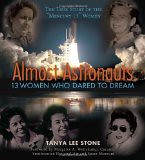
Almost Astronauts: 13 Women Who Dared to Dream Tanya Lee Stone

(This book was also shortlisted for the YALSA award)

This is the story of the women who wanted to be astronauts in the early days of the American Space Program. At that time, a woman pilot was an idea that didn't sit well with many people, let alone a woman astronaut. But, some women tried and proved they were better suited than men for the job.

But, in the end, the groundbreaking women who tried, failed to get into space. It wasn't until 1983 that the US sent its first woman into space. Even then, she was a Mission Specialist, not a pilot. It wasn't until 1999 that the US had its first woman commander of a space shuttle.

With a lot of cultural history thrown in, this book focuses not only on women in flight and space, but also on the role of women in society in the last fifty years. The end looks at why there still aren't that many women in space. Part of the problem is lack of women going into science and engineering and possibilities why.

There has been a lot of talk about how this is history that's trying to make a point. See, for instance, Liz's excellent post. I don't have a big problem with that. Most history books (and this gets truer the older the intended audience is) have an agenda or point of view. Personally, I like a more blatant point of view, because it's easier to then think about what's not getting said to prove the point. This is a very good teaching moment for children in evaluating sources and knowing that just because a source has a point of view doesn't mean it's not valid.

Overall, this was very interesting and an enjoyable read. It's also very well documented, with a further reading list, extensive bibliography, source notes, and index.

I read this for the Cybils and would have been on my personal short list if I were allowed 10 books instead of 5.

Book Provided by... the publisher, for Cybils consideration.


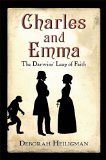
Charles and Emma: The Darwins' Leap of Faith Deborah Heiligman

This is the story of Charles and Emma Darwin's marriage and life together. There is certainly much of Charles's work and research, but it is more a sketch of their home life, and the work is mentioned in how it affected their family. When it comes down to it, it was a question of faith-- Charles's science led him more and more towards atheism, while Emma, although rather liberal (especially for the time) in her theistic views, was still deeply religious and often feared for her husband's soul. But this didn't cause much strain in their relationship, instead, Emma acted as Charles's sounding board, helping him determine all the objections he would have to address in order to make a convincing argument.

We also see how Darwin observes everything around him to think about his theories of evolution-- he looks at his children, at the plants in the garden, and spends much time talking to experts in every field to learn more and more and more.

I most enjoyed seeing how they raised their children. Unlike many Victorians, their children were allowed to run all over the house and freely voice their thoughts and feelings. It was nice to have proof that even though the Darwin's weren't the norm, some people didn't believe that children needed to be "seen and not heard."

An engaging read, and interesting and different window into Darwin's life. One of the things that makes it so engaging is how much the Darwin's wrote to each other (especially about religion, deep fears were hard to express face to face, so they'd write letters, even when they weren't apart) so there is a lot more dialog and feeling in this biography than you normally get. AND! It's all sourced at the end, so you know it's not fictionalized. There's also a really helpful family tree in the back that I wish I had noticed before I finished the book! Everyone's related and several people have similar (or the same) names, so it can be a little hard to keep everyone straight.

While I don't think this book will be picked up by many teens on their own, it will be enjoyed by those that give it the second look and open it up.

Book provided by... my local library

Links to Amazon are an affiliate link. You can help support Biblio File by purchasing any item (not just the one linked to!) through these links. Read my full disclosure statement.

Sunday, January 17, 2010

Sunday Salon: ALA, new computers, and more

Greetings! I am blogging this from my brand new computer. No more will I be a victim to my computer's slow and painful death! No more I say! I still need to do my spreadsheet post and also do my 2009 wrap up! But I need to wait until my files finish transferring from my old computer. Also, I made the switch from PC to Mac. It's taking awhile to get used to. What the @#@$% is this command key? Where's my page down key? What do you mean I can't forward delete. Ah well. The biggest thing is that the key board is just a slightly different size, so my typing is suffering as I adjust.

In the meantime, how about some predictions for tomorrow when the ALA Youth Media Awards are announced?

Caldecott:

The Lion and Mouse by Jerry Pinkney. Hands down.

I'm also a big fan of The Negro Speaks of Rivers.


Newbery:

I'm not sure who will win and who will honor, but I'm pretty sure these books will be there:

When You Reach Me
Where the Mountain Meets the Moon
Claudette Colvin: Twice Towards Justice
Evolution of Calpurnia Tate

Siebert:

Claudette Colvin will win. Day-Glo Brothers and Frog Scientist will honor.

Coretta Scott King illustrator:

The Negro Speaks of Rivers

Printz:

Not sure which will win and which will honor but we'll see the following on the list:

Marcelo in the Real World
WIntergirls
If I Stay

The New YALSA nonfiction award:

Claudette Colvin


Links to Amazon are an affiliate link. You can help support Biblio File by purchasing any item (not just the one linked to!) through these links. Read my full disclosure statement.