Showing posts with label Renaissance. Show all posts

Wednesday, August 27, 2014

Duchessina

Here's a post that originally ran in the now-defunct Edge of the Forest

Duchessina: A Novel of Catherine de' Medici Carolyn Meyer

Catherine de’Medici is mostly known as the power behind the throne during the reigns of her ineffective sons, the kings of France. History has also placed her with the blame of the St. Bartholomew’s massacre in which over two thousand Huguenots were killed. Not much is known about the early life of Catherine de’Medici, beyond her use as a pawn in various Florentine power struggles.

In this latest installment in her Young Royals series, Carolyn Meyer’s imagination fills in the gaps in her story. Orphaned as an infant, she is known as Duchessina, the little Duchess after her duchy in Urbino. She grows up in Florence, in the Plaza de Medici under the watchful eye of her cardinal uncle, the future Pope Clement VII. After her guardian uncle assumes the pontificate, Italy is plunged into several wars against the Holy Roman Emperor, Charles V. Catherine is eight at the time and does not completely understand the political machinations at play as the citizens of Florence take the excuse to reassert their independence from Medici rule. Catherine is taken as a war hostage and sent to an anti-Medici convent. She then changes convents from time to time as the turmoil mounts and recedes. Eventually, Catherine is taken to Rome to be with the Pope as he arranges her marriage to the French dauphin.

Once in France, Catherine’s life does not become easier. It is obvious her new husband’s affections lie elsewhere. But, with the skills she has learned, she makes a place for herself.

This is an exciting tale with historic splendor, adventure, love, and true friendship. Unfortunately, the historical notes at the end act mainly as an epilogue to her life, not as illuminating background information to the events of the book. During the Italian Wars, the young Catherine does not fully understand the political maneuverings at play, and as she is the narrator, neither does the reader. Also, there is nothing to let the reader know which details of the story are fact, and which sprung from Meyer’s mind. It is also interesting to note that Catherine’s speaking voice is the same at the age of three as it is as an adult.

(note-- I did go an read an adult biography of her, Leonie Frieda's Catherine de Medici: Renaissance Queen of France, which I reviewed here in 2007)


Book Provided by... The Edge of the Forest, for review

Links to Amazon are an affiliate link. You can help support Biblio File by purchasing any item (not just the one linked to!) through these links. Read my full disclosure statement.

Tuesday, August 07, 2007

Dragon Ladies

I promise kid/YA books later this week, today's more adult non fiction, but with really good reason!

I have reviews up today in the new issue of Edge of the Forest. Head over there to read lots of reviews and cool stuff, as well as my thoughts on Leap and Duchessina: A Novel of Catherine de' Medici.

Now, when reviewing a work of historical fiction, it's always nice to know something about the time period. If you're reviewing a novelization of someone's life, you should know something about that person besides what Wikipedia and Biography Resource Center (my favorite biography database) can give you.


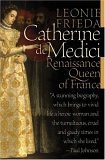
So, I turned to Catherine de Medici: Renaissance Queen of France by Leonie Frieda.

This is an exhaustive look at a complicated woman. Catherine was Queen of France, and mother to 3 kings of France. She held most of the power during the religious civil wars, was a contemporary of Queen Elizabeth (Elizabeth's "Frog" was Catherine's youngest son) and history has placed the blame for the Saint Bartholomew's Day massacre squarely at Catherine's feet.

Frieda has tried to free Catherine of this blame-- she paints a picture of a surgical assassination gone horribly wrong but... the fact that she wasn't guilty of massacre, just ordering the political killings of a dozen men? I'm not entirely sure that makes her better.

Frieda writes a compelling story about a place and time period I know little about. She explains context extremely well and her story is well researched and well told-- for my research, I really only needed the first few chapters, but I was so intrigued by Frieda's portrait that I had to continue reading.

There are 3 inserts of color photographs and paintings that serve as great visual aids and I really appreciated the "Cast of Characters" at the beginning of the book--it's hard to keep all those Henri's straight, plus the ever-changing Duke of Guise...

If you like biography, France, powerful women, religious history, or Renaissance history, I recommend this book.

Another powerful woman who is often a controversial figure is Madame Chiang Kai Shek.

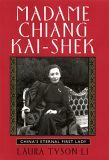
In Madame Chiang Kai-shek: China's Eternal First Lady by Laura Tyson Li, we get another look at a complicated and complex person.

I think Li really wanted this to be a sympathetic view of Madame Chiang Kai- Shek, but after a certain point, the material just wouldn't let her. I learned a lot about Taiwan, as well as the craziness that was the first 50 years of the twentieth century in China. (1911 brought the overthrow the the Qing Dynasty and the new Republic, which never fully gained control of all of China-- much was ruled by warlords, then the Communists were making noises so there was that war, then the Japanese were invading, so there was that war, then back to the Communists...)

After reading this book, I finally understood why Communism succeeded in China and why many saw it as a much better alternative to Chiang's government. But oh, she played the American government and people like a fiddle to get support for a losing cause for years. The KMT (Guomingdang) only lasted as long as it did because of US support...

A revealing and fascinating look at the birth of Communist China, China/Taiwanese political tensions, and the woman who stood in the middle of it all.